Media Text
A text is any media product we wish to examine, whether it is a television program, a book, a poster, a popular song, the latest fashion, etc. We can discuss with students what the type of text is—cartoon, rock video, fairy tale, police drama, etc.—and how it differs from other types of text. We can identify its denotative meaning and discuss such features as narrative structure, how meanings are communicated, values implicit in the text, and connections with other texts. This concept leads to three broad areas within which we can raise questions that will help students to "deconstruct" the media: text, audience and production. more in Representation. Anyone who receives a media text, whether it is a book read alone or a film viewed in a theatre, is a member of an audience. It is important for children to be able to identify the audience(s) of a text. Texts are frequently designed to produce audiences, which are then sold to advertisers. http://www.medienabc.org/page5/page40/page40.html
 http://www.games73.com/media.games73.com/files/2012/12/ME3-title.jpg
A text is any media product we wish to examine, whether it is a television program, a book, a poster, a popular song, the latest fashion, etc. We can discuss with students what the type of text is—cartoon, rock video, fairy tale, police drama, etc.—and how it differs from other types of text. We can identify its denotative meaning and discuss such features as narrative structure, how meanings are communicated, values implicit in the text, and connections with other texts. This concept leads to three broad areas within which we can raise questions that will help students to "deconstruct" the media: text, audience and production. more in Representation. Anyone who receives a media text, whether it is a book read alone or a film viewed in a theatre, is a member of an audience. It is important for children to be able to identify the audience(s) of a text. Texts are frequently designed to produce audiences, which are then sold to advertisers. http://www.medienabc.org/page5/page40/page40.html
 http://www.games73.com/media.games73.com/files/2012/12/ME3-title.jpg
Semiotics Semiotics, or semiology, is the study of signs, symbols, and signification. It is the study of how meaning is created, not what it is. Below are some brief definitions of semiotic terms, beginning with the smallest unit of meaning and proceeding towards the larger and more.
Signifier: any material thing that signifies, e.g., words on a page, a facial expression, an image.
Signified: the concept that a signifier refers to. Together, the signifier and signified make up the.
Sign: the smallest unit of meaning. Anything that can be used to communicate (or to tell a lie). Symbolic (arbitrary) signs: signs where the relation between signifier and signified is purely conventional and culturally specific, e.g., most words.
Iconic signs: signs where the signifier resembles the signified, e.g., a picture.
Indexical Signs: signs where the signifier is caused by the signified, e.g., smoke signifies fire.
Denotation: the most basic or literal meaning of a sign, e.g., the word "rose" signifies a particular kind of flower.
Connotation: the secondary, cultural meanings of signs; or "signifying signs," signs that are used as signifiers for a secondary meaning, e.g., the word "rose" signifies passion.
Metonymy: a kind of connotation where in one sign is substituted for another with which it is closely associated, as in the use of Washington for the United States government or of the sword for military power.
Synecdoche: a kind of connotation in which a part is used for the whole (as hand for sailor).Collections of related connotations can be bound together either by
Paradigmatic relations: where signs get meaning from their association with other signs,or by
Syntagmatic relations: where signs get meaning from their sequential order, e.g., grammar or the sequence of events that make up a story.
Myths: a combination of paradigms and syntagms that make up an oft-told story with elaborate cultural associations, e.g., the cowboy myth, the romance myth.
Codes: a combination of semiotic systems, a supersystem, that function as general maps of meaning, belief systems about oneself and others, which imply views and attitudes about how the world is and/or ought to be. Codes are where semiotics and social structure and values connect.
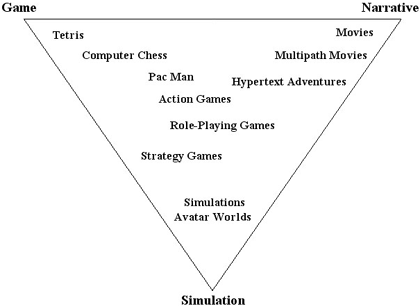
Ideologies: codes that reinforce or are congruent with structures of power. Ideology works largely by creating forms of "common sense," of the taken-for-granted in everyday life.http://www.uvm.edu/~tstreete/semiotics_and_ads/terminology.html http://www.gamestudies.org/0501/lindley/figure2_420.gif
Signifier: any material thing that signifies, e.g., words on a page, a facial expression, an image.
Signified: the concept that a signifier refers to. Together, the signifier and signified make up the.
Sign: the smallest unit of meaning. Anything that can be used to communicate (or to tell a lie). Symbolic (arbitrary) signs: signs where the relation between signifier and signified is purely conventional and culturally specific, e.g., most words.
Iconic signs: signs where the signifier resembles the signified, e.g., a picture.
Indexical Signs: signs where the signifier is caused by the signified, e.g., smoke signifies fire.
Denotation: the most basic or literal meaning of a sign, e.g., the word "rose" signifies a particular kind of flower.
Connotation: the secondary, cultural meanings of signs; or "signifying signs," signs that are used as signifiers for a secondary meaning, e.g., the word "rose" signifies passion.
Metonymy: a kind of connotation where in one sign is substituted for another with which it is closely associated, as in the use of Washington for the United States government or of the sword for military power.
Synecdoche: a kind of connotation in which a part is used for the whole (as hand for sailor).Collections of related connotations can be bound together either by
Paradigmatic relations: where signs get meaning from their association with other signs,or by
Syntagmatic relations: where signs get meaning from their sequential order, e.g., grammar or the sequence of events that make up a story.
Myths: a combination of paradigms and syntagms that make up an oft-told story with elaborate cultural associations, e.g., the cowboy myth, the romance myth.
Codes: a combination of semiotic systems, a supersystem, that function as general maps of meaning, belief systems about oneself and others, which imply views and attitudes about how the world is and/or ought to be. Codes are where semiotics and social structure and values connect.
Ideologies: codes that reinforce or are congruent with structures of power. Ideology works largely by creating forms of "common sense," of the taken-for-granted in everyday life.http://www.uvm.edu/~tstreete/semiotics_and_ads/terminology.html
http://www.gamestudies.org/0501/lindley/figure2_420.gif
Genre
Media products can be classified into categories or genre. The word 'genre' comes from the French word meaning 'type' or 'class'. Media genres appear within a medium (film, television) such as the "horror" film or the television "situation comedy".A genre can be recognised by its common set of distinguishing features (see discussion on codes and conventions). These features associated with a genre's style and content may be, for example, a particular setting, character types, technical codes (lighting or music). You may also find that some media texts blur genre boundaries.Audiences recognise these features and therefore expect certain things. For example, at the end of a romantic comedy film the two lead characters will realise they are in love. Audiences may even select a text on the basis of its genre.Producers market texts according to genre because a niche audience has already been identified as taking pleasure in that type of text.However, a genre is not static – it changes all the time – resulting in hybrid (or sub-) genres and changing codes and conventions. There is also a relationship between genres and the societies in which they are created.http://media-studies.tki.org.nz/Teaching-media-studies/Media-concepts/Genre
Media products can be classified into categories or genre. The word 'genre' comes from the French word meaning 'type' or 'class'. Media genres appear within a medium (film, television) such as the "horror" film or the television "situation comedy".A genre can be recognised by its common set of distinguishing features (see discussion on codes and conventions). These features associated with a genre's style and content may be, for example, a particular setting, character types, technical codes (lighting or music). You may also find that some media texts blur genre boundaries.Audiences recognise these features and therefore expect certain things. For example, at the end of a romantic comedy film the two lead characters will realise they are in love. Audiences may even select a text on the basis of its genre.Producers market texts according to genre because a niche audience has already been identified as taking pleasure in that type of text.However, a genre is not static – it changes all the time – resulting in hybrid (or sub-) genres and changing codes and conventions. There is also a relationship between genres and the societies in which they are created.http://media-studies.tki.org.nz/Teaching-media-studies/Media-concepts/Genre

Selection of content
Selection of content is when the developers choose the final colors and design put onto the game and game case. For example this means the different images and objects that are used, and the text font and size. This is all important to appeal to the target audience because certain fonts and other themes will not be suitable for a game with a younger audience viewing so they need to make sure that the theme suits the target audience

Construction of content
The construction of content is how to interface between player and game is constructed. For example this is done when you can pick multiple answers to reply to an AI. This is good for the players as it can broaden the story line making the players personalize there story too they're specific needs.
Codes and conventions
Codes are systems of signs, which create meaning. Codes can be divided into two categories – technical and symbolic, Symbolic codes show what is beneath the surface of what we see. For example, a character's actions show you how the character is feeling.Conventions are the generally accepted ways of doing something. There are general conventions in any medium, such as the use of interviewee quotes in a print article, but conventions are also genre specific.Codes and conventions are used together in any study of genre – it is not enough to discuss a technical code used such as camera work, without saying how it is conventionally used in a genre.
For example, the technical code of lighting is used in some way in all film genres. It is a convention of the horror genre that side and back lighting is used to create mystery and suspense – an integral part of any horror movie.
http://media-studies.tki.org.nz/Teaching-media-studies/Media-concepts/Codes-and-conventions
Modes of address
Modes of address can be defined as the ways in which relations between addresser and addressee are constructed in a text. In order to communicate, a producer of any text must make some assumptions about an intended audience; reflections of such assumptions may be discerned in the text (advertisements offer particularly clear examples of this).
https://uk.answers.yahoo.com/question/index?qid=20081102051549AAzx5lm
Codes are systems of signs, which create meaning. Codes can be divided into two categories – technical and symbolic, Symbolic codes show what is beneath the surface of what we see. For example, a character's actions show you how the character is feeling.Conventions are the generally accepted ways of doing something. There are general conventions in any medium, such as the use of interviewee quotes in a print article, but conventions are also genre specific.Codes and conventions are used together in any study of genre – it is not enough to discuss a technical code used such as camera work, without saying how it is conventionally used in a genre.
For example, the technical code of lighting is used in some way in all film genres. It is a convention of the horror genre that side and back lighting is used to create mystery and suspense – an integral part of any horror movie.
http://media-studies.tki.org.nz/Teaching-media-studies/Media-concepts/Codes-and-conventions
Modes of address
Modes of address can be defined as the ways in which relations between addresser and addressee are constructed in a text. In order to communicate, a producer of any text must make some assumptions about an intended audience; reflections of such assumptions may be discerned in the text (advertisements offer particularly clear examples of this).
https://uk.answers.yahoo.com/question/index?qid=20081102051549AAzx5lm




No comments:
Post a Comment